Leave No Trace Elopement Photography: What It Means in Practice
These Places Aren't Backdrops
There's a photo that circulates every summer. A couple standing in an alpine meadow — not beside the wildflowers, in them. A bride with an armful of picked lupine. A pink smoke bomb going off under the spruce in August.
I'm not going to name anyone, because that isn't the point, and because most of the people in those photos have no idea. That's the actual problem. Nobody wakes up on their elopement day intending to damage the place they chose specifically because they love it. But intent and impact are different things, and out here the gap between them is where the damage lives.
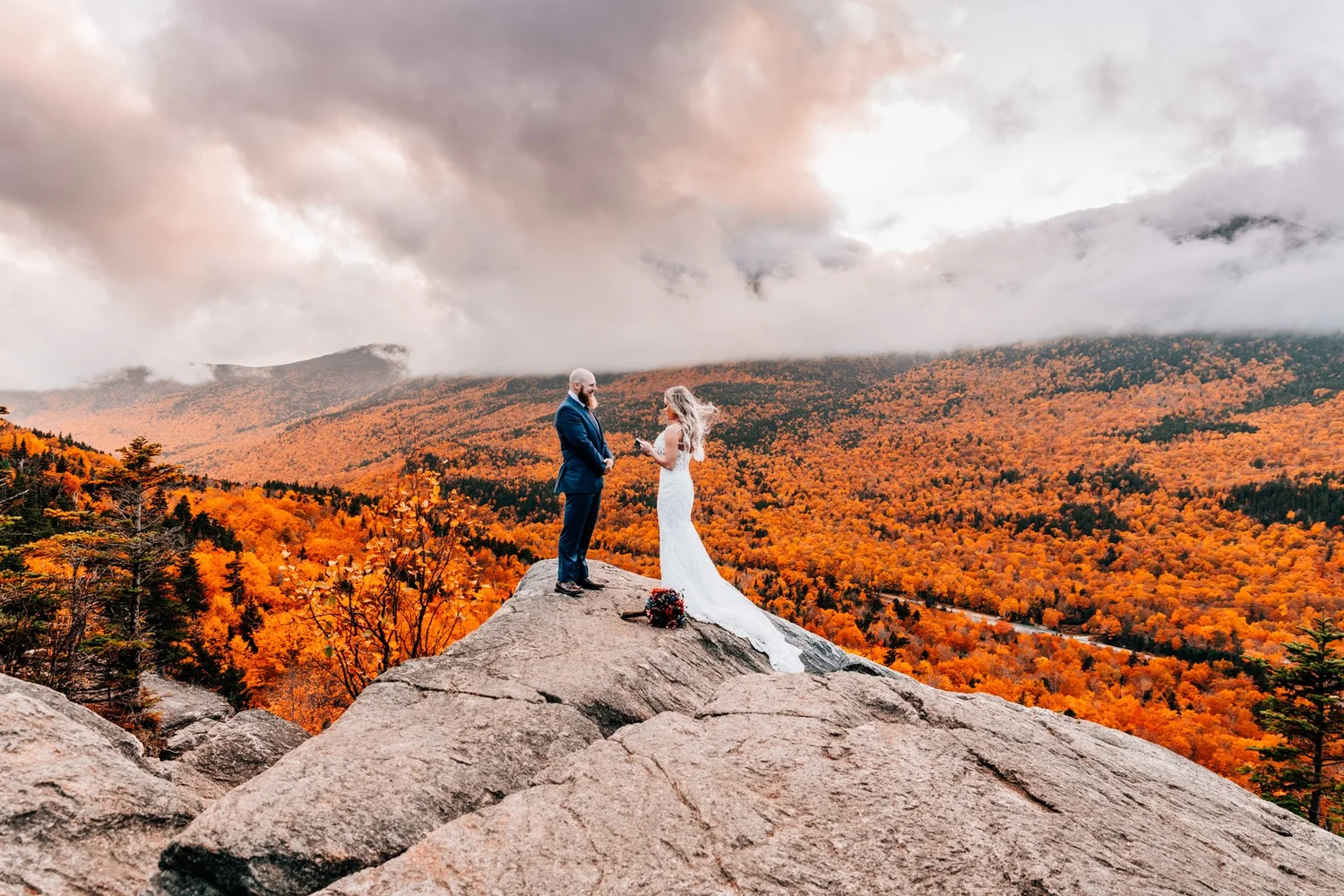
Where this work happens
Almost all of my work happens on public land. National forest, state park, White Mountain trailheads, ridgelines above treeline. That's not incidental to elopement photography — it's the whole premise. People elope in these places because they're wild and don't look like a ballroom.
Here's the thing about those places: they're not backdrops. They're critical wildlife habitat. They're ecologically sensitive in ways that aren't visible from inside the frame. And they were already under real pressure from tourism long before anyone showed up with a dress and a camera. The alpine zone in the White Mountains is a genuinely rare environment — plants living at the edge of what they can tolerate, in soil that took an extraordinarily long time to accumulate. Vegetation up there doesn't bounce back over a season. A boot print in the wrong place can persist for years.
The margin for error is thinner than it looks.
The traditions nobody questions
Wedding culture comes with rituals that are harmless in a reception hall and destructive on a mountain. Confetti. Glitter. Smoke bombs. Sky lanterns. Rice. A Bluetooth speaker playing the first-dance song at a volume the whole cirque can hear.
People love this stuff, and I understand why. The disconnect is that none of it was designed with a fragile place in mind.
Let me be precise, because the environmental case for some of these gets made badly. You may have heard that rice kills birds — that it expands in their stomachs. That's a myth. But rice is still litter, and it's food litter, which teaches wildlife to associate people with an easy meal. A habituated animal is a dead animal eventually. The real argument doesn't need the fake one.
Glitter and plastic confetti are microplastics. You are not picking them back up.
Smoke bombs are the one I get asked about most, and the harm isn't the one people expect. The color is dye particulate — it settles onto rock and vegetation and it stains, and it stays. Weeks after the couple has gone home and posted the photos, somebody else hikes to that overlook and finds it streaked magenta. That's an impact nobody photographs, because by the time it matters the shoot is over. They're also prohibited outright in many of the places I see them used. And while the cool-burning devices sold for photography are lower-risk than an open flame, lower isn't none: a smoke bomb at a gender reveal party started the El Dorado Fire in 2020, which burned nearly 23,000 acres of the San Bernardino National Forest and killed a firefighter.
Sky lanterns are the serious fire risk — an open flame released into the air, landing somewhere you'll never see. There's no version of that which is safe in a forest, and no version where you carry it back out.
Amplified music changes how wildlife forages and how much time they spend alert instead of eating. It also, more mundanely, wrecks the afternoon for the twelve other people who hiked four miles for some quiet. Both matter. The second one matters more often.
What we owe the places we profit from
Here's where I'll be blunter. Plenty of photographers don't think this through. They pick the location that photographs best, let the couple do whatever they want, and post the results. I don't think that's usually malice — it's a blind spot, plus a real professional fear: nobody wants to be the vendor who tells a couple no on the most important day of their life.
I'd push back on that anyway. We are profiting off public land. That's the business. These places are the product, and we didn't build them, don't own them, and don't pay for their upkeep in any proportion to what we take from them.
If a place is generating my income, protecting it is part of the job.
And I'll be honest about the harder part: it is hard to educate people on environmental issues. Not everybody cares. But the reach here is unusual — a photographer with an audience is showing thousands of future couples what an elopement is supposed to look like. Every smoke bomb photo is an advertisement for the next smoke bomb. That influence runs both directions, which is exactly why it's worth using deliberately.
What I actually do
Enough theory. Here's the operational version.
It's in my contract. Not as a suggestion. Clients sign a Leave No Trace agreement as part of booking, so we're aligned long before anyone's standing on a ridge.
Clause 7
Leave No Trace Agreement
Clients agree to abide by LNT principles during photography on public lands.
Violations may result in session termination without refund.
Key points include
- Leave only footprints; carry in / carry out.
- No glitter, confetti, smoke bombs, rice, food tosses, lantern or balloon releases, or any other items that create litter or lasting impact.
- No loud music, amplified speakers, or disruptive noise that negatively impacts other visitors or wildlife.
- Be considerate of other visitors and share the space respectfully.
- Stay on trails (especially in alpine and wilderness zones) unless stepping off is absolutely necessary and does not impact vegetation.
- Do not take or disturb plants, rocks, or other natural features.
- Do not disturb or feed wildlife; view from a distance only.
- Follow all regulations and permit requirements, including group size limits.
- Camp and make fires only in designated, legal areas.
Putting it in writing does something a friendly reminder can't. It sets the expectation at booking, when nobody's emotional and nobody's already bought the confetti cannons. By the time we're on location it isn't a new rule I'm imposing — it's something we already agreed on.
I match the location to the group. This is the highest-leverage decision I make, and I make it before anyone leaves the parking lot. Ten guests means a spot that can absorb ten people — durable surface, room to spread out, enough trail that nobody has to bushwhack for a view. Ten people in a place built for two is how meadows get flattened, and no amount of in-the-moment reminding fixes a location choice that was wrong from the start.
I steer away from the most fragile places, even when they'd photograph beautifully. I'm generally not going to suggest a sensitive alpine meadow. That's a real cost — some of those spots are spectacular. I'd rather find you something equally good on ground that can take it, and there's more of that than people assume.
I say something in the moment. Above treeline I remind people what they're standing on and why the rock matters more than the green stuff. If a speaker comes out of a pack, I mention the other hikers and the wildlife. Not as a lecture — just as information, the way you'd mention it's about to get cold. Most people adjust immediately once they understand there's a reason. The resistance photographers expect from clients mostly doesn't materialize. Couples who choose to get married on a mountain generally love that mountain. They just haven't been told which parts of it are fragile.
The ask
None of this is a purity test. I've made mistakes out there, and Leave No Trace has never been about achieving zero impact — that isn't possible. The principles are about minimizing it, and making deliberate choices instead of accidental ones.
What I'd ask of other photographers is smaller than it sounds. Put it in your contract. Choose locations that can hold your group. Be willing to say "not that spot," and to say it early, when it's an easy conversation instead of a confrontation. And think about what your feed is teaching the next thousand couples about what a day like this looks like.
These places let us make a living inside them. The least we can do is leave them the way we found them.